
 Dr Rolf called fascia the “organ of structure”.
The role of fascia as a whole body system has the capacity to alter movement patterns far from the sight of any restriction. This was to Dr Rolf an important component to creating lasting structural and postural change – leading to a body that tends towards economy and ease of movement, rather than what Dr Rolf would call a ‘Random’ body – Struggling to find peace with itself.
For a Rolfing practitioner the importance of fascia, muscle, and bone can be considered as one functional unit:
- Each muscle fibre is encased in fascia
- Each group of fibres is encased in fascia
- Each muscle is encased in fascia
This encasing fascia of the muscles then moves towards a common tendon that connects the muscle to the bone. This then forms itself around the bone as another combination of the Connective Tissue matrix – keeping the continuity alive.
This interconnectedness clearly show how the body and its ability to function can be compromised by any misadventure within the myofascial system.
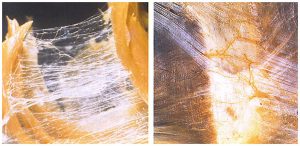 If we can take the cross-section of a leg of lamb (apologies to those who may find this reference unappealing) as an example, Fascia is the marbly bit that separates one muscle from the other. If you go one step further and try to pull the muscle off the bone, fascia is the cobweb like tissue that stretches between the muscle and bone, or within the muscle itself.
Reinforcing the need to look at the body as an interconnected 3 Dimensional structure
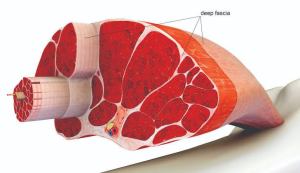 Fascia enwraps muscles fibres, which enwrap whole muscles, which in turn become tendons or ligaments, which then attach to bone – surrounding the bone itself. The fascia that surrounds the bone then goes on to connect to another muscle or internal structure, which then does the same to its neighbours. As you can see there is continuity going on from one structure to another, with all muscles, organs, nerves, and vessels attached to one another
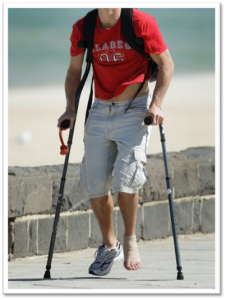 For example:
Imagine you have a fall and injure your left leg, and as a result you limp for a few weeks.
This limping will be altering the natural ‘function’ of your walking pattern.
Your left hip may rise higher than your right to compensate. Your head may also thrust forward to balance your hips.
Imagine if you were to just go on with this pattern and slowly over time it ‘healed’, in such a way that a new pattern was put in the place of your original. It is here that the problems arise.
Fascia which links all the segments of the muscular system when the body is healthy, may also reshape the body when it is pulled out of alignment.
Visualize our example of the injured leg — as the altered patterns push the body out of alignment the fascia being elastic will take on the newfound limitations of movement and posture.
This may lead to the creation of a new sense of what it may feel like to be standing “up right” or moving forward.